
Core: ESP32 1.0
The host module — the brain every Attaky build is built around. It runs the firmware, drives the screen, and connects every other module.
Core: ESP32 1.0 is the host module — the brain of an Attaky. It runs the firmware, drives the screen and controls, talks to every module you attach, and connects to Wi-Fi and Bluetooth. Every current Attaky build is built on a Core.

Looking for the technical specs?
Pinouts, the I²C map, interfaces, and sensor parts are on the Core: ESP32 datasheet.
On board
- A 2.0-inch 240×320 color touchscreen
- Five front keys — four direction keys and an enter key — in a column down the right side
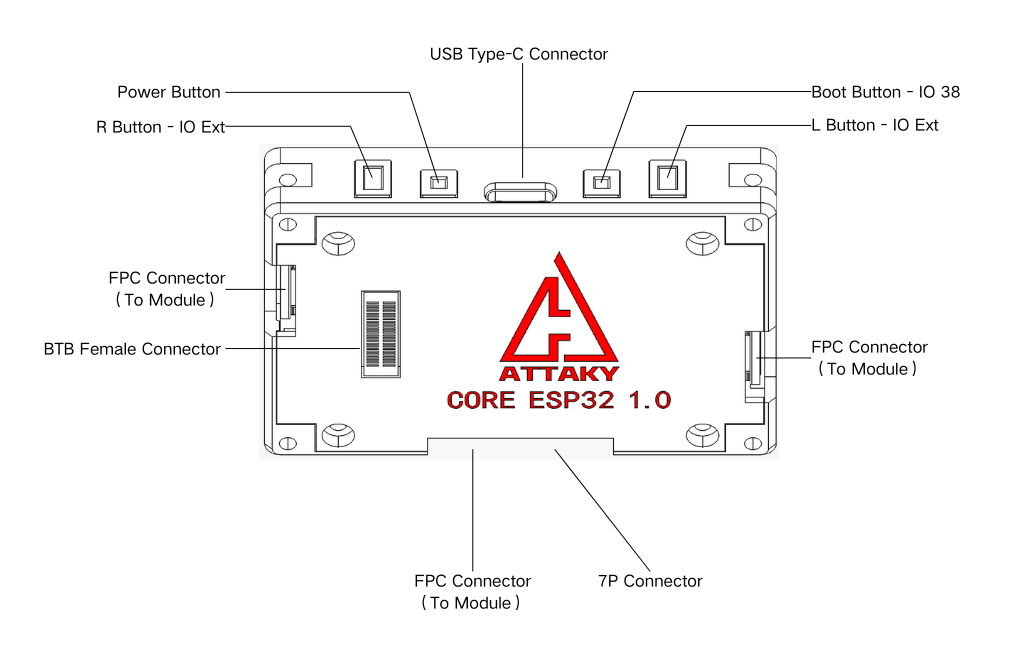
- Four top buttons: L1, boot, power, and R1 (left to right)
- Wi-Fi and Bluetooth LE
- A 6-axis motion sensor and an ambient-light sensor (for auto-brightness)
- USB-C for charging the battery, flashing, and the serial console
- An RGB status light
What you do with it
On its own, Core is the brain waiting for a job. Attach an Expand module to give it a capability — a LoRa radio, a microSD-and-speaker media kit, an FM/AM tuner — then flash a firmware to match. The same Core becomes an off-grid communicator, a retro console, a radio, or a voice assistant depending on what you pair and flash.
Explore the modules you can add and the firmware you can flash.
How it connects
Core sits at the center of the build: an Expand module attaches at the back, a Control module along the bottom, and a Power module supplies it — all through Attaky's standard connectors. See Frame & Connections for the standard, and Swap a Module when you want to change one.
Good to know
Power button — a long press (about two seconds) turns the device on when it's off, and off when it's on. It's a hardware switch, so it always works, even if the firmware is busy.
Size — 66 × 46 × 12 mm.
Specs
For the full hardware specification — pinout, I²C map, interfaces, and sensors — see the Core: ESP32 datasheet.
Get one
Core: ESP32 comes in every current build — see Series to pick one.